
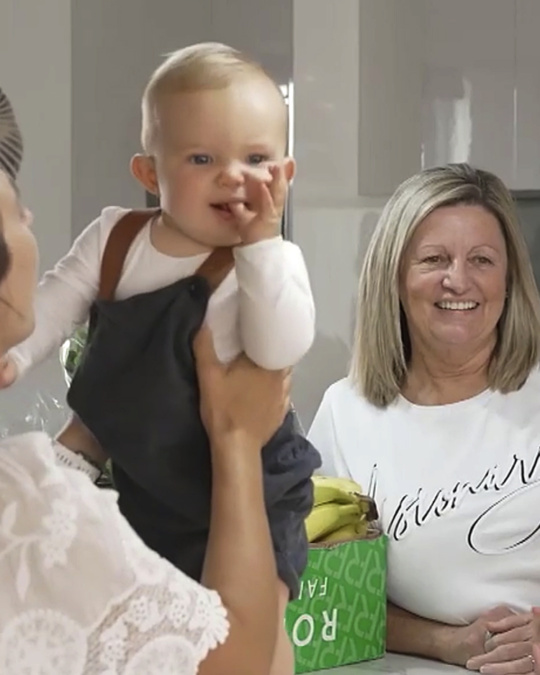


Taking home an AED from work helps to save the life of her mum
“FRx AEDs are foolproof. All you do is turn it on and it talks you through it from there. You never know when you may need it. Having access to an AED can literally be the difference between life and death of a loved one.”
Carly Ryan
As Regional Manager of Royal Life Saving, Carly Ryan estimates that she has used a training AED “thousands” of times in her role as an instructor. Before leaving her office for the Christmas holiday, she decided to take a Philips HeartStart FRx AED home with her.
“Living near the water and a location that sees a lot of people and families relaxing and recreating, I thought it (the AED) may be more beneficial to be accessible to me over the break in case an incident occurred near my home, as opposed to sitting in a vacated office,” Carly explains.
It was just before 4:30 a.m. on January 14, 2021, Carly’s mum and dad, Robyn and Kym, were asleep in the Warilla, Australia house they share with Carly and her partner.
“I woke up with a real tightness in my chest,”
Robyn says. She then kicked the sheet off the bed and complained to her husband, Kym, about the pain in her chest. He asked her if she was okay but got no response. Kym turned on the bedroom light and noticed that his wife was unconscious, and her skin was blue. He immediately yelled to Carly and her partner for help and began CPR.
“I screamed to my daughter for an ambulance. I started CPR immediately, as I knew she needed it. She was blue and grey from the neck up,” he said.
Carly remembers running upstairs and seeing her mum on the bed and her dad doing CPR.
“Within the next few seconds, I remembered I had the AED in my car. I jumped off the bed, ran past my partner who was on the phone to the emergency services and retrieved the AED from my back seat. As soon as I came back up, I opened the device and placed the pads on mum’s chest and told Dad to stop CPR as it analyzed the situation.”
Putting her training into practice
As an AED instructor, Carly says until that point, she had only used the HeartStart FRx AED in training, never in a real-life situation.
“It was simple and, thankfully, effective. We had the AED on mum for almost nine minutes in total and shocked her twice in that time. It was honestly the same as when I train, only a real casualty was on the other end.”
Robyn opened her eyes but didn’t respond to her name being called. As she was beginning to regain consciousness, the paramedics arrived. Robyn recalls that the evening before they had gone out for a family dinner and she felt fine. “I am pretty active. I work full-time at a hospital, and I enjoy walks with my husband.”
Although the 63-year-old had no pre-existing conditions, she says that she had experienced random chest pain during the night in the months leading up to the incident.
“This happened enough that I booked in with my doctor to check how I was. I actually had a blood test on the Wednesday morning (the day before my arrest). I also had a form in my bag to book in for a stress test.” Robyn explains.
Robyn knows that she’s lucky given the statistics. Sudden Cardiac Arrest (SCA) occurs in a home or residence 69.8% of the time.1 Fifty percent of middle-aged adults who experienced SCA had no warning signs.2 The other 50% had warning signs in the months, weeks and days leading up to their SCA, but only 19% called their doctor to report the symptoms.3
Most of the people who experience an out-of-hospital cardiac arrest, 90% do not survive.4 The good news is that immediate CPR and early defibrillation, with an AED, can more than double a victim’s chance of survival.5
Philips HeartStart FRx: side by side, step by step
With her life-saving background, Carly knows how important it is to know CPR and have an AED nearby.
“We were able to retrieve the data from the AED after the incident and saw a total working time of approximately nine minutes. We can see mum’s heart was in Ventricular Fibrillation (VF). Although quality CPR was being conducted, mum’s heart had suffered an electrical malfunction,” Carly explains.
“If this occurs to someone’s heart, they require a shock from a defibrillator as soon as possible to restore normal activity. We were able to have the pads on mum and a shock delivered within two minutes of her going into cardiac arrest: the speed of this is critical. Without the AED application and shocks within the first few minutes and ensuing shocks, the chance of mum surviving would have been extremely thin.”
Carly’s message is simple: with a little training, anyone can use the HeartStart FRx AED. The device contains simple directions and “talks” through the process with audio instructions and will only deliver shocks if the patient needs them, analyzing their heartbeat first.


