
“AEDs save lives, and that’s the bottom line. You can’t afford not to have one.”
Brad Floy
Brad Floy has been an athletic trainer for the University of Iowa Hawkeye men’s basketball team for 14 years. He’s also an adjunct professor in the Department of Health and Human Physiology at the University of Iowa, where he teaches several courses, including first aid and CPR.
The last thing on his mind as the team began their practice was that he would have to use an AED to save the life of one of his 20-year-old basketball team student-managers. Floy had used an AED one time before – in 2014 – on an older gentleman who was walking on the concourse of the Carver Hawkeye Arena.
“I always thought that, if I used an AED again, it would be on an older staff member or someone in the crowd during a game,”
Floy said.
His heart wouldn’t rebound
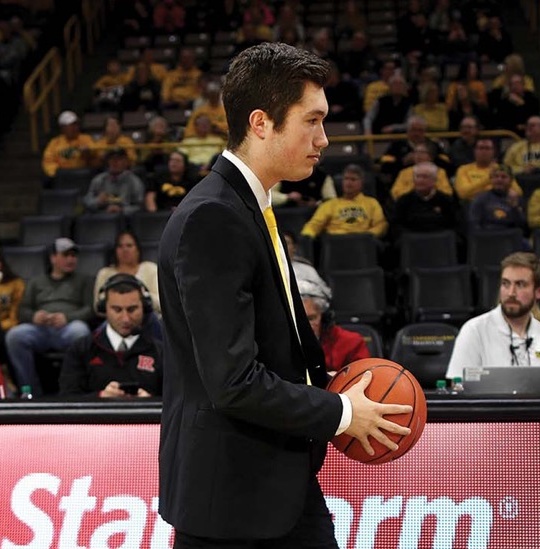
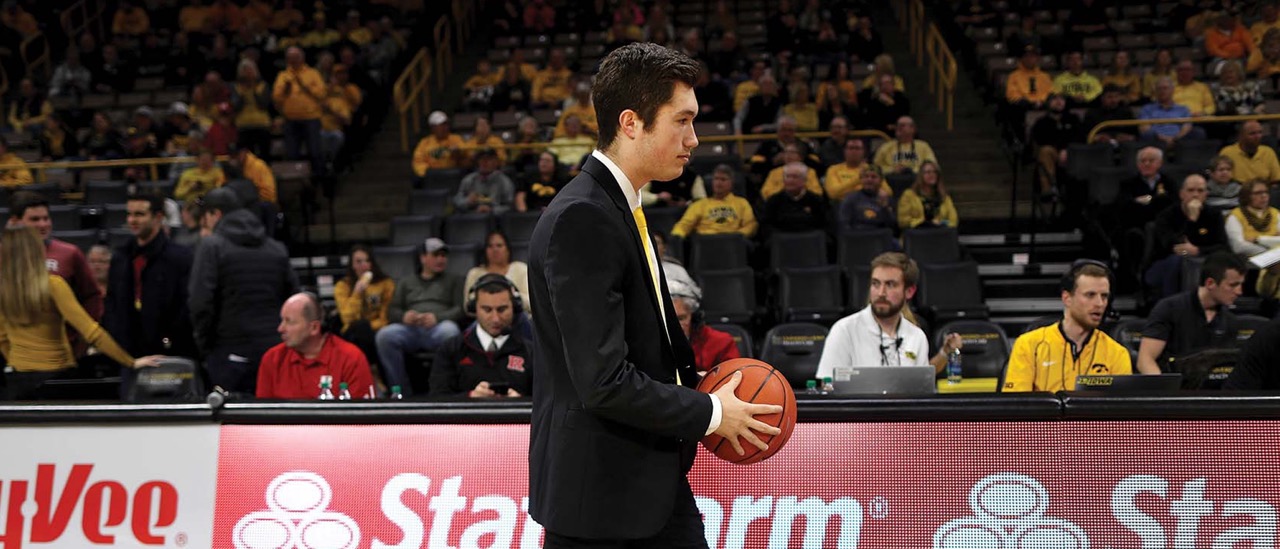
Luke Slavens, an athletic, 20-year-old University of Iowa student, is also a student-manager for the Hawkeye men’s basketball team. One of his tasks is to rebound basketballs for the players during practice.
“I remember there were three players at my hoop, and I wasn’t exerting myself very much as I was standing in the same spot for most of the time. I think it was towards the end of the drill that I started to feel a little dizzy,”
said Slavens. That’s when the team members told Slavens to sit down and called over Floy to take a look.
“I remember being able to walk over to the chair, but my head felt very heavy as I sat down,”
Slavens said.
That’s when Floy sprang into action.
“I asked him a few questions such as if he was sick, what has he had to eat, drink, etc. He looked pale and stopped answering my questions after a short moment.”
Recalls Slavens,
“Brad told me later that he had asked me some simple questions, which I had answered. But, I don’t remember. I pretty much blacked out once I sat down.”
Floy quickly assessed the situation.
“My first thought was that he was going to faint, so I helped him off the chair he was sitting on and lowered him to the ground. I was checking his pulse and watching his breathing during the questioning and after laying him on the ground. He then had some seizure-like spasms that made me think he might be going into a grand mal seizure. But then he suddenly stopped breathing, lost his pulse, and his lips turned light blue.”
A couple of heart-stopping minutes
Floy instructed his student-assistant to call 911, as he grabbed the AED located on the other side of the basketball court. He gave orders to clear the gym and to get the campus police who were in the arena for a women’s basketball game that was about to begin.
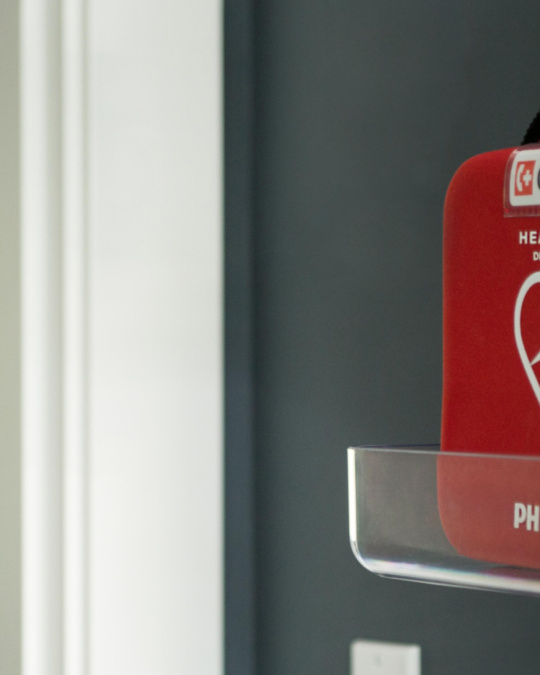
Floy used the Philips HeartStart FRx AED.
“I applied the pads to his chest and turned it on for analysis. It advised a shock, so I delivered one shock. After re-analysis, I began CPR,”
he explained.
When the campus police arrived, one of the officers helped give rescue breaths while Floy gave compressions.
“After we did about 45 seconds of CPR, Luke regained consciousness and pushed the mask off his face that the officer was using for rescue breaths. I couldn’t believe what just happened. Cardiac arrest events don’t usually have such ideal and quick outcomes, but in this case the AED worked perfectly,”
Floy said.
As the EMS crew entered the gym, Slavens opened his eyes. From the time he lost consciousness until he was defibrillated with the AED, Floy estimates that Slavens’ heart had stopped for a full 2-3 minutes.
“Once I saw Brad and the EMTs, I had a pretty good idea of what had happened and that it was probably related to my heart condition, Brugada Syndrome. It sounds crazy, but after those first 10 seconds of waking up, I thought they were going to help me up and we were going to go back to practice,”
Slavens said.
When he was 10 years old, Slavens was diagnosed with Brugada Syndrome, a genetic disorder that causes disturbances affecting the electrical system of the heart. Although having Brugada Syndrome never affected his ability to play sports or be active, Slavens met with his doctor annually. Each year, his doctor would say that he didn’t see any reason to place an internal defibrillator in Slavens’ chest. In fact, said Slavens,
“At our last meeting, he said I didn’t need to be seen for two years.”
Quick thinking saved the day
After hearing that, the idea of having an episode wasn’t on Slavens’ mind. Adds Floy,
“You never expect anything like this to happen. But you have to be prepared for it.”
Floy is grateful that the University of Iowa understands the value of having intuitive and easy-to-use AEDs on site and located strategically throughout their buildings.
So is Slavens.
“I think the outcome probably would have been very different if there was no AED. Brad would have had to save me with CPR, and that could have been tougher to do. I could have been unconscious longer, which would have led to other health issues, so I’m very lucky that there was an AED there,”
Slavens said.