How Philips HeartStart AEDs Adapt to Help Save Lives: A Guide to User-paced Guidance

Imagine this: You are at work, grabbing coffee in the break room, when a colleague suddenly collapses. Panic sets in. You know there’s an automated external defibrillator (AED) on the wall, but you’ve never actually used one. You aren’t a doctor or an EMT. You just want to help.
In that high-pressure moment, you need a device that is designed to not confuse or rush you. You need a partner.
User-paced guidance, found only in Philips HeartStart AEDs, can be your partner. This technology guides the rescuer—you—through the process calmly and effectively. Today, we’re discussing how this feature makes these devices accessible to everyone, regardless of medical training.
The reality of sudden cardiac arrest (SCA)
SCA can happen to anyone, anywhere, at any time, no matter your age, physical fitness, or health history. When it strikes, the heart stops beating effectively, and blood flow to the brain and other vital organs ceases.
In these moments, time is the enemy. For every minute that passes without CPR and defibrillation, the chance of survival decreases by 7-10%. This is a frightening statistic, but it’s why having an AED nearby is critical.
However, simply having the device isn’t enough. People need to feel confident enough to use it. Many people hesitate because they are afraid of doing something wrong. They worry they might hurt the victim or they won’t understand the AED’s instructions.
Hesitation can cost a life, which is why usability isn’t just a “nice-to-have” — it’s critical.
What is User-paced guidance?
People learn at different speeds. Some can fly through instructions, while others need a moment to process what they are hearing. Now, apply that to a life-or-death emergency where adrenaline is pumping, and your hands might be shaking.
Standard AEDs often follow a fixed script; the AED doesn’t detect what you are doing. The device might give an instruction and then move on to the next step, whether you’re ready or not.
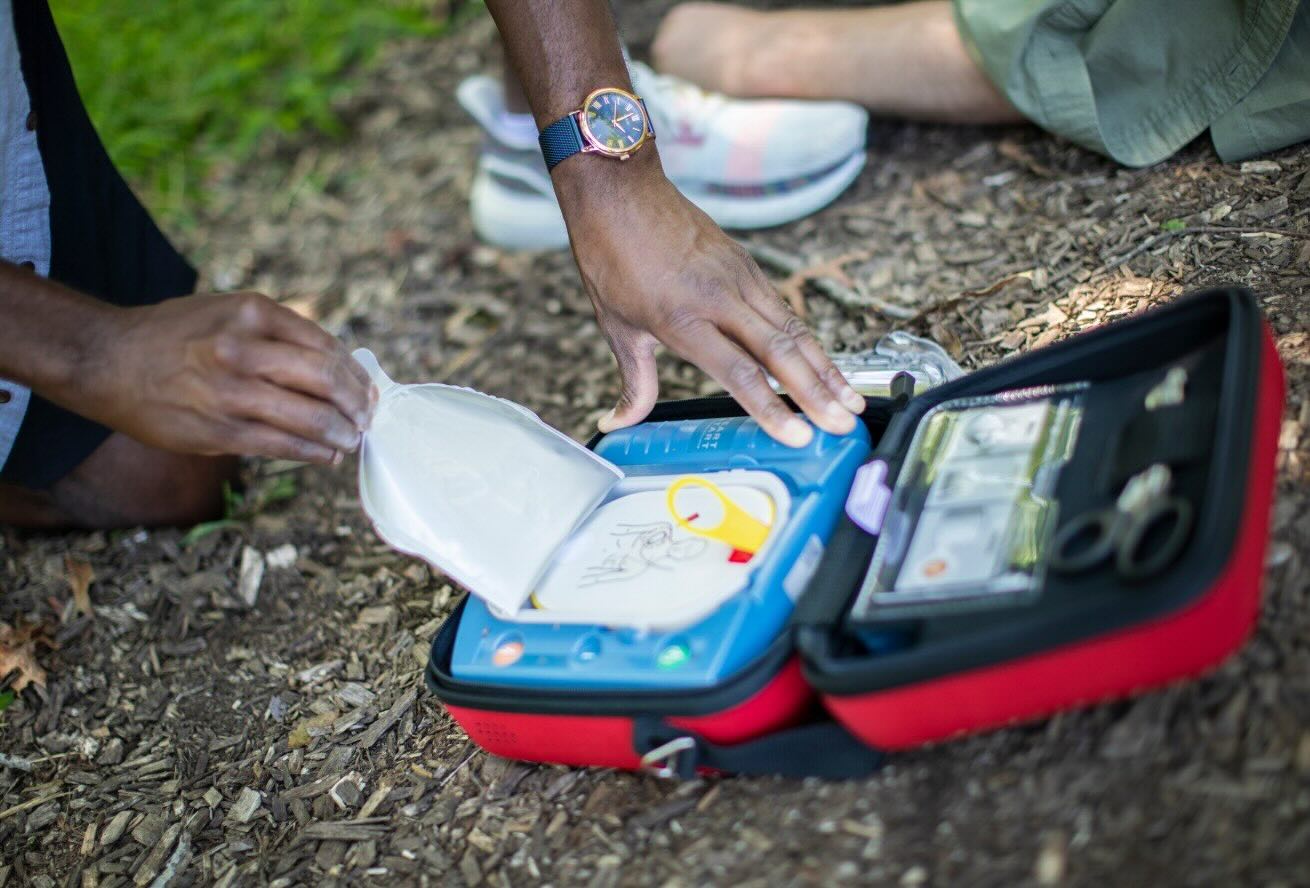
User-paced guidance is the solution to this problem. Philips HeartStart AEDs are designed to keep pace with your actions. The devices use sensors to track your progress with the pads and provides “smart” voice instructions that match what you’ve done. Here is how user-paced guidance works:
- It waits for you: If you are struggling to open the pad package, the voice prompts won’t skip ahead to “place pads on patient.” It will repeat or rephrase the current instruction until it senses you have completed the task.
- It provides details when needed: If the device senses you are stuck or taking too long, it will offer more detailed instructions to help keep you progressing.
- It speeds up if you are fast: If you are a trained responder who knows exactly what to do, the device recognizes your speed and advances, saving precious seconds.
Philips HeartStart AEDs adjust to match your pace. They treat you like a partner, not just an operator.
Why User-Paced Guidance Matters
For HR managers and Facilities Directors, selecting safety equipment is about risk management and employee well-being. When you choose an AED, you are betting that your staff will be able to use it effectively during a crisis. Here is why user-paced guidance is a game-changer for workplace safety:
- It can help reduce anxiety
Panic is the biggest barrier to action. Knowing that the device will “hold your hand” and won’t rush, it can help lower the anxiety threshold. This can help make it more likely that an employee will step up and attempt a rescue. - It Bridges the Training Gap
While we always recommend CPR and AED training, certification expires, and skills fade. In the heat of the moment, people forget what they learned in a classroom two years ago. User-paced guidance acts as a real-time coach, filling in the gaps of memory and training. It allows a layperson with zero medical background to perform life-saving actions with a high degree of accuracy.
Compliance Made Easy
For those managing safety compliance, user-paced guidance offers another hidden benefit: peace of mind.
When you install AEDs that are easier to use, you are reducing the liability risk associated with failed rescues due to user error. You are demonstrating a higher level of care for your employees by providing equipment that is specifically designed for lay responders.
Furthermore, integrating these devices into your safety program is straightforward. Because they are so intuitive, they complement your existing emergency response plans perfectly. You don’t need to worry about complex, specialized training just to teach people how to turn the machine on. The machine teaches them as they go.
Ready to learn more about protecting your workplace?
Safety isn’t just about equipment; it’s about readiness. If you are looking to upgrade your current AEDs or are installing them for the first time, consider how user-paced guidance can make a difference in your organization.
Contact us today to discuss which Philips HeartStart solution fits your office environment and budget. Let’s make sure your team is ready for anything.
Please consult device Instructions for Use for indications, contraindications and safety information. Heartstream is the official brand license partner of Philips HeartStart AEDs.
Save stories
Having a home AED helped save the person closest to his heart

Boot campers work as a team to save one of their own
Fitness fanatic saves a life at sports club during intense, unexpected ultimate workout

How one man’s sudden cardiac arrest was intercepted under the Friday night lights

Teamwork and quick thinking

AED gives Australian woman a new lease on life
How can we help you?
Contact a Heartstream sales representative
Get in touch