How Philips HeartStart OnSite AED Programs Are Saving Lives Every Day
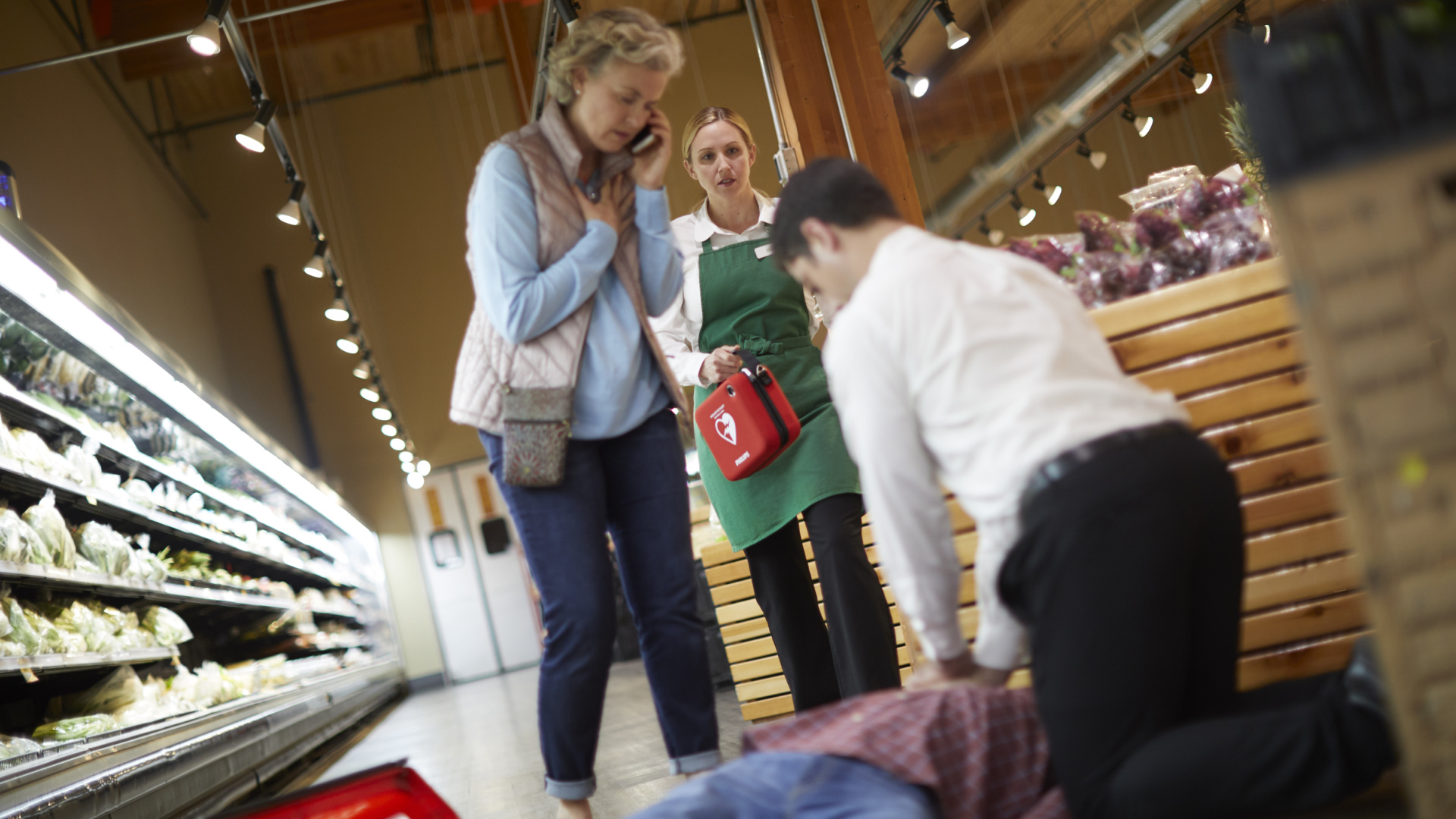
Sudden cardiac arrest does not wait for an ambulance. When a person collapses, the clock starts ticking. Every minute that passes without a shock from a defibrillator lowers the chance of survival by 7-10%.[1] But what happens when the people nearby are ready, trained, and equipped to act?
We have an exciting study to share—one that reflects the power of community and corporate responsibility. A comprehensive, 92-month observational study of a major supermarket chain reveals exactly what happens when businesses invest in safety.[2] By placing automated external defibrillators (AEDs) in grocery stores and distribution centers and training employees to use them, this grocery chain achieved a remarkable 51% survival rate to hospital discharge for cardiac arrest victims.
This represents a sudden cardiac arrest survival outcome far better than traditional emergency response. In this post, we will explore the incredible findings of this peer-reviewed study, the role of trained employees, and how any grocery store or public market can step forward into this next chapter of public safety.
The Reality of Sudden Cardiac Arrest
Statistically, when a person experiences out-of-hospital cardiac arrest, only about 10% percent of patients survive to hospital discharge when relying solely on an emergency medical services (EMS) response.[3]
This low survival rate is not a failure of our paramedics. It is primarily a matter of time and distance. In the US, the average EMS response time is approximately 7 to 12 minutes for urban and suburban areas, and it can extend to over 14 minutes in rural settings.[4] However, for a person in cardiac arrest, CPR plus defibrillation within 3 to 5 minutes of collapse can produce survival rates as high as 75%.[5]
One way to bridge this gap in time is to look to the people who are already on the scene. By equipping public spaces with AEDs, we can empower ordinary people to deliver extraordinary care.
A Lifesaving Model
A large regional
supermarket chain decided to take action. They installed Philips HeartStart OnSite AEDs across 1,358 stores and two dozen corporate and warehouse locations and trained their staff in CPR and AED use.
Over the course of 92 months, researchers tracked every time a Philips HeartStart OnSite AED was pulled from the wall. The results were astounding: store employees retrieved and applied an AED an average of four times per month.
The 51% Survival Rate
The most inspiring finding from this extensive study is the survival rate. Among the patients who had a shockable heart rhythm and were tracked through hospital discharge, at least 51% survived.[6] Most importantly, almost of all those resuscitated patients were alive and neurologically-intact a year later.6
Is a 51% survival rate good?
Yes, a 51% survival rate exceedingly outperforms the typical 5-10% EMS-only survival outcomes.[7] This number represents mothers, fathers, co-workers, and friends who returned home to their families.
These outcomes happen because the delay to the first shock is drastically reduced. When an OnSite AED is located near the checkout counters, and an employee knows exactly what to do, care begins in seconds rather than minutes. This rapid response is essential to preserving a neurologically intact, healthy life after a sudden cardiac arrest.
Everyday Heroes in the Aisles
A program like this does not succeed because of the AED alone. It succeeds because people believe in it, support it, and bring it to life every day.
When researchers look
ed at who was leading the rescue efforts, the numbers told a story of an extraordinary level of emergency readiness and leadership. In 86% of the shockable events, the store employees themselves led the CPR and AED use, and in 83% of the non-shockable events where CPR was required, employees also took charge.[8]
These employees are not medical professionals. They are retail workers who stepped out of their daily routines to perform chest compressions and follow the clear, calm voice prompts of an HeartStart OnSite AED. They were willing to retrieve the AED and use it, leading to a significant improvement in the survival outcomes of their neighbors.
Sudden Cardiac Arrest can strike anyone, anywhere
It is easy to assume that sudden cardiac arrest only happens to the elderly. However, the study data tells a very different story. The majority of the patients who received a lifesaving shock were people in their forties, fifties, and sixties.[9]
Many of thes
e patients were store employees, so the trained staff members were not just saving customers; they were saving their co-workers.
The results of this study highlight a profound benefit of corporate Philips AED programs. Training employees protects the public and the team. Furthermore, employees carry these AED skills home with them, benefiting their family members and the community at large.
Building a Unified Philips HeartStart OnSite AED Program
By following the model below, you can send a unified and confident message to the world. We show we value human life and are prepared to protect it. To replicate this success in any grocery store, here are the key steps to take:
- Install visible equipment: Place Philips OnSite AEDs in highly trafficked, easy-to-reach areas. Do not hide them in back offices.
- Invest in regular training: Teach staff how to recognize a sudden cardiac arrest, perform CPR, and use the AED. Refresh their training every two years.
- Maintain AEDs: Routinely check battery levels and replace expired pads to ensure devices are fully functional.
- Foster a culture of action: Ensure management makes it clear to employees they support stepping up to use the Philips HeartStart OnSite AED.
A Call to Action for All
Installing Philips HeartStart OnSite AEDs in grocery stores is an example of what can be done in all other businesses and workplaces.
If we equip public spaces with Philips AEDs and empower the community to respond, we can build a future where surviving a sudden cardiac arrest is the expectation, not the exception.
[1] Sudden Cardiac Arrest Foundation. (n.p.). Myths and Facts. Retrieved April 09, 2026 from https://www.sca-aware.org/about-sudden-cardiac-arrest/myths-and-facts.
[2] Kenneth A. Scheppke, Paul E. Pepe, Remle P. Crowe, Junwei Jiang, Eric K. Scheppke, Steve A. McCoy,
Deployment of automated external defibrillators by a supermarket chain, The American Journal of Emergency Medicine, Volume 101, 2026, Pages 147-151, ISSN 0735-6757, https://doi.org/10.1016/j.ajem.2025.12.033.
[3] American Red Cross. (n.p.). CPR Facts & Statistics. Retrieved April 09, 2026 from https://www.redcross.org/take-a-class/resources/articles/cpr-facts-and-statistics.
[4] Mell, H. K., Mumma, S. N., Hiestand, B., Carr, B. G., Holland, T., & Stopyra, J. (2017). Emergency Medical Services Response Times in Rural, Suburban, and Urban Areas. JAMA surgery, 152(10), 983–984. https://doi.org/10.1001/jamasurg.2017.2230.
[5] American Heart Association. (2005). Part 4: Adult basic life support. Circulation, 112(24_suppl), IV-19–IV-34. https://doi.org/10.1161/CIRCULATIONAHA.105.166553
[6] Kenneth A. Scheppke, Paul E. Pepe, Remle P. Crowe, Junwei Jiang, Eric K. Scheppke, Steve A. McCoy,
Deployment of automated external defibrillators by a supermarket chain, The American Journal of Emergency Medicine, Volume 101, 2026, Pages 147-151, ISSN 0735-6757, https://doi.org/10.1016/j.ajem.2025.12.033.
[7] American Red Cross. (n.p.). CPR Facts & Statistics. Retrieved April 09, 2026 from https://www.redcross.org/take-a-class/resources/articles/cpr-facts-and-statistics.
[8] Kenneth A. Scheppke, Paul E. Pepe, Remle P. Crowe, Junwei Jiang, Eric K. Scheppke, Steve A. McCoy,
Deployment of automated external defibrillators by a supermarket chain, The American Journal of Emergency Medicine, Volume 101, 2026, Pages 147-151, ISSN 0735-6757, https://doi.org/10.1016/j.ajem.2025.12.033.
[9] Kenneth A. Scheppke, Paul E. Pepe, Remle P. Crowe, Junwei Jiang, Eric K. Scheppke, Steve A. McCoy,
Deployment of automated external defibrillators by a supermarket chain, The American Journal of Emergency Medicine, Volume 101, 2026, Pages 147-151, ISSN 0735-6757, https://doi.org/10.1016/j.ajem.2025.12.033.
Save stories
Having a home AED helped save the person closest to his heart

Boot campers work as a team to save one of their own
Fitness fanatic saves a life at sports club during intense, unexpected ultimate workout
How one man’s sudden cardiac arrest was intercepted under the Friday night lights

Teamwork and quick thinking

AED gives Australian woman a new lease on life
How can we help you?
Contact a Heartstream sales representative
Get in touch